Running an Autonomous System for fun and negative profit
I blame the fact that I have a lot of hobbies, and I wanted to learn about BGP and control my own IP space. This has been an adventure since 2017.
This is a crazy project I recommend to anyone who is also insane enough to have their home network be fully enterprise hardware.
I will fully blame 100% of this concept coming into my head on Kenneth Finnegan. I regularly follow his blog as his hobbies overlap with mine pretty well. He wrote a blog way back in 2017 about setting up an AS in his local colo. Since then, I’ve been trying to find ways to do that same sort of project.
My project criteria
Kenneth’s project was pretty much exactly what I wanted to do, but I had a few criteria for myself that I wanted to meet:
- I wanted to be able to run this from my house. I don’t have or want to need a colo for the time being.
- I wanted to have my own direct assigned IP space, and not have to rely on a provider for that.
- I wanted to be able to run this on a budget, and not have to spend a ton of money on hardware or power costs.
But most of all, I wanted to learn about BGP and how it works in a real world environment, and not just in a lab environment from my CCNA studies.
Cue me basically cloning Kenneth’s project initially.
Timeline
2017
Hardware
Kenneth’s project started out with a Cisco Catalyst 6506, I also ended up buying one of these cheap on eBay and picking it up locally. That decision was quickly turned into a scrap heap, as the power costs of running it would have tripled the budget I had for power in this project. Oh well, only $120 or so down the drain.
Networking
The biggest challenge about running this from a home network is your ISP is almost guaranteed to try to push you into a very expensive and overkill direct fiber connection before they’ll let you peer with them outside of an internet exchange. At the time, my ISP (Cogeco) was giving me only DOCSIS 3.1. This was an annoying problem because it effectively ruled out BGP entirely due to how their network was laid out. I had to then bide my time until I had a chance of scenery.
2020
Hardware
Jumping forwards a few years, my hardware choice had been pretty much stagnant; but I was always on the lookout for a peering capable router that I could use for this project. I’d been eyeing Cisco ASR1001-X’s for a while, but they were still in service and therefore obscenely expensive.
I wanted to stay with Cisco as most, if not all of my experience was on Cisco hardware. This also meant I could use the plethora of very well documented Cisco IOS features to make this project a lot easier to manage and run.
Networking
I’d recently moved into a new house, but unfortunately Cogeco was still the only reasonable ISP in the area. I did actually request a quote for a full fiber buildout to the address, but I was quoted a 5 year contract with a $1000/mo bill. Nope.
2023
For the last year, I had been looking at buying a house in a much different area with my partner, and ultimately landed on a house in a very rural area. This was a gamble in more ways than one, as when we signed the papers for the house, we had no actual ISP in the area other than our very backup-backup plan of Starlink for the time being.
This led to us(me) doing a lot of calling around to find out who and where all the ISPs in the area were. My options were slim to none, with the entire area being serviced from a single WISP.
I signed up for service with the WISP, and they were able to get me up and running with a 100/100 connection. This was a nice short term win, but I knew that with a WISP the stability was not going to be fantastic as it relied on bounce points all over the county back to their main hub.
Ontario has a great map of broadband projects to areas that are deemed “Broadband poverty” and with who the ISPs receiving funding are for the areas.
My area was in the planned buildout area for Mornington Communications, a local co-op ISP that serviced most of my county. I reached out to them and ended up getting in contact with quite a few amazing people in both their management team, as well as their networking team.
My request was to make sure that my neighborhood was included in the buildout, and that I could get a fiber connection to my house. Once that was confirmed, I was able to actually start planning on how to get my AS up and running…
2024
We bought the property late 2023, and I spent the winter mostly planning and prepping for the buildout. I had to do a lot of work on the property to get it ready for the fiber buildout, as I had a detached garage I wanted to use as the core of the network. This also meant getting a lot of documentation in line for applications to ARIN.
We also had a lot of other projects on the go with the house, many of those will merit their own post such as:
- Buying a 90ft antenna tower and have it be a horizontal lawn ornament for a year or so.
- Buying a fiber fusion splicer and running fiber everywhere outside the house, and to the garage.
- Setting up PLCs for random projects around the house, and building out some projects with them.
- Wiring the chicken coop with Ethernet.
- Lots of garden projects.
2025
Networking
Mornington finally finished their buildout in early 2025, and I was able to get connected to their network with regular non-excessively overkill internet in April 2025. This was a massive win, as it meant that our internet speeds could finally actually support some of the nonsense I wanted to do, but more importnatly it was stable enough without drop outs based on the power availability of the upstream bounce points from the WISP.
Hardware wise, I had settled on using a Cisco ISR 4331 for the time being.
Actually getting an ASN
I won’t go into too much detail here, as the paths to getting an ASN in a region depend heavily on the RIR for that region. For me, it was ARIN. This means I need to register an org identifier, and then apply for an ASN with cause. This is where my handy dandy corporation came in, as I was able to use that for the org identifier and ASN application. (I can never understate how useful having a corporation instead of a sole proprietorship is for projects like this, as it allows you to have a lot more freedom in what you can do with the project and how you can manage it.)
My org identifier was approved quickly after paying $50.
The ASN application was a bit more of a process, as I had to provide a lot of documentation about my current plans and why I needed an ASN as it like IP addresses are technically a finite resource.
Once approved, I had to pay the initial fee registry payment of $250 for the ASN, and then I was allowed to start applying for IP space.
IP Allocation Rules
ARIN has a fantastic detailed document about who, why, and how you may be assigned IP address spaces. IPv4 addresses globally have been exhausted for a while, so the only way to get IPv4 space is through the transfer market, or a very lengthy waitlist.
The alternative, though requiring a lot more paperwork and effort on your side is to get IPv6 space and a /24 as part of the ARIN 4.10 allocation scheme.
This is ultimately what I applied for, as I thought why not dive into IPv6 while I’m at it. (This is a story for another time, but I would recommend the adventure of deploying IPv6 to anyone who is currently just on a v4 network.)
4.10 is probably the most complicated but satisfying allocation scheme. It’s not a “free” allocation, in the sense that you can transfer it to others like the other methods, but instead you are specifically blocked from transferring it within ARIN, or outside ARIN to ensure that the policy is not misused.
For me, this fits perfectly, as the reasoning for the IP space and the logic I provided are truthful as the IP space will indeed be used for those reasons. I’m also in complete agreement with the concept of stewardship of IP space, and I have no intention of keeping this /24 allocation long term and I plan to replace it with a different allocation in the future.
June 2025
Finally online with my own ASN (401167) and my own /24 v4 and /40 v6 allocations!
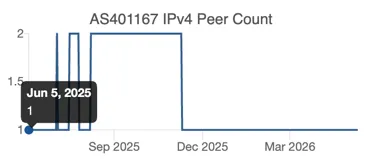
I can’t understate how much of a one off this kind of success is. Mornington is a genuinely amazing ISP, and I can’t thank them enough for working with me on this project and making it a reality. Everyone I chat with there is genuinely amazing, and a huge shoutout to both Ken and Dave.
2026
I recently swapped to taking full internet tables (All 1+M v4 and 300k+ v6 routes) from Mornington. This on its own was a challenge as the 1M routes don’t fit on most RAM/RIB setups on the ISR4331.
I’ve got plans to upgrade to an ISR1001 in the future, but I need to get more RAM for it and upgrade to 16GB in order to make it remotely plausible to run full tables on it. For now, the 4331 cries every time there’s a routing table update, and momentarily times out connections.